
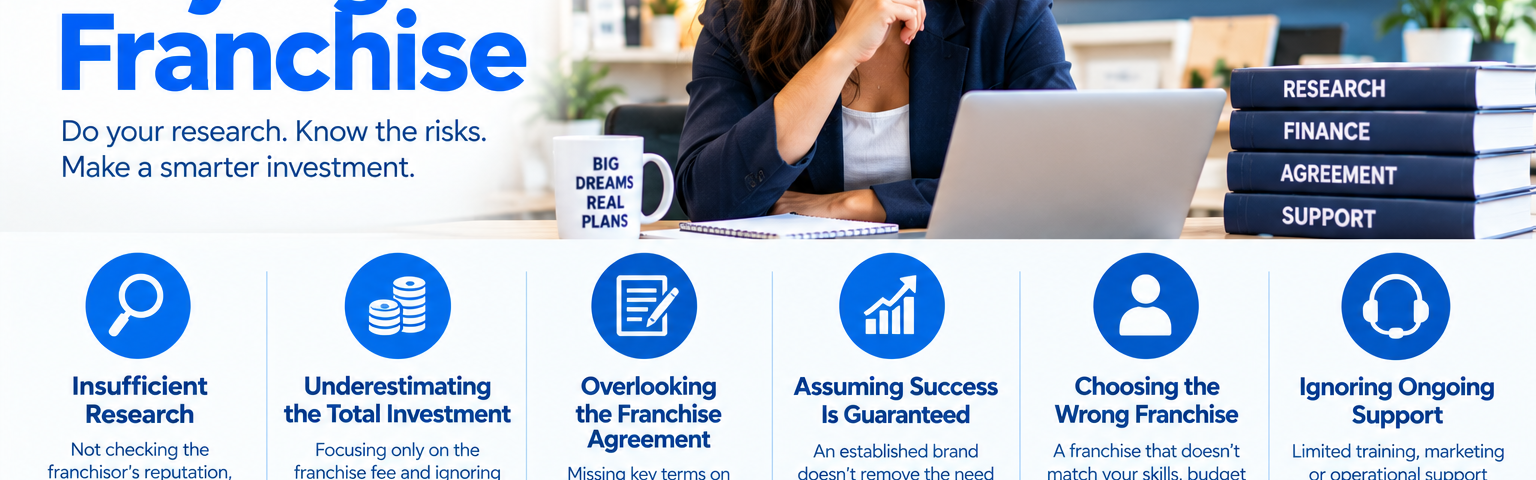
Buying a franchise can be an attractive route into business ownership, offering access to an established brand, a proven business model, and ongoing support from a franchisor. However, franchising is not a guaranteed path to success. Like any business investment, it involves financial risks, contractual obligations, and operational challenges that prospective franchisees must understand before making a commitment.
Many of the problems associated with franchise ownership arise from insufficient research, unrealistic financial expectations, or a misunderstanding of the franchise agreement. By recognising the most common pitfalls before investing, prospective franchisees can make more informed decisions and improve their chances of building a sustainable and profitable business.
Failing to Research the Franchise Thoroughly
One of the biggest mistakes prospective franchisees make is investing in an opportunity without conducting sufficient research. A recognisable brand and an attractive sales presentation do not necessarily indicate that a franchise is financially successful or suitable for every investor.
Before committing, it is important to investigate the franchisor’s reputation, business history, financial stability, and performance across its franchise network. Speaking with existing franchisees can provide valuable insight into the actual experience of running the business, including the quality of support and the challenges they encounter.
Understanding the local market is equally important. Customer demand, competition, location, and economic conditions can all influence whether a franchise succeeds.
Underestimating the Total Investment
Another common pitfall is focusing only on the initial franchise fee rather than the full cost of establishing and operating the business. Depending on the franchise, additional expenses may include premises, equipment, stock, staff recruitment, insurance, marketing, and professional fees.
Franchisees must also account for ongoing royalties, advertising contributions, rent, utilities, and other operating costs. These expenses can significantly affect profitability, particularly during the early months when revenue may be unpredictable.
Creating a realistic financial forecast and maintaining sufficient working capital can help prevent cash flow problems. Prospective investors should also consider unexpected expenses and test how the business would perform if sales were lower than anticipated.
Overlooking the Franchise Agreement
The franchise agreement defines the legal relationship between the franchisor and franchisee. Failing to understand its terms can lead to costly problems later.
Important provisions may cover royalty payments, contract duration, renewal rights, territory restrictions, operating standards, termination, and restrictions on selling or transferring the business.
Some agreements limit the franchisee’s ability to make independent decisions about pricing, suppliers, products, and marketing. These restrictions may be reasonable within the franchise system, but investors should understand their implications before signing.
Obtaining independent legal advice from a professional experienced in franchising can help identify potential risks and clarify contractual obligations.
Assuming Success Is Guaranteed
Buying into an established franchise does not guarantee profitability. Although brand recognition and established systems can provide advantages, business performance still depends on customer demand, operating costs, management quality, and local competition.
Franchisees must be prepared to work hard, manage employees, maintain service standards, and respond to changing market conditions. Even a well-known franchise can struggle if it is poorly located or managed inefficiently.
It is therefore important to evaluate financial projections critically rather than relying solely on optimistic sales forecasts or promises of strong returns.
Choosing the Wrong Franchise
A franchise that works well for one investor may not suit another. Some businesses require significant daily involvement, while others need specialised skills, larger investments, or experience managing employees.
Prospective franchisees should consider their budget, interests, experience, preferred working hours, and long-term objectives. They should also assess whether the franchisor’s culture and operating requirements align with their expectations.
Choosing a franchise solely because it is popular or appears profitable can result in frustration if the day-to-day responsibilities do not match the investor’s lifestyle or abilities.
Ignoring the Importance of Ongoing Support
Franchisor support can be an important factor in the success of a franchise business. However, the level and quality of support vary between franchise systems.
Before investing, prospective franchisees should establish what training, marketing assistance, operational guidance, and ongoing development are included. They should also ask existing franchisees whether the support provided meets expectations.
A franchise with limited support may require the owner to solve more problems independently, increasing the demands of running the business.
Conclusion
Buying a franchise can provide a structured route into business ownership, but avoiding common pitfalls is essential to making a sound investment. Thorough research, realistic financial planning, careful review of the franchise agreement, and a clear understanding of operational responsibilities can help reduce unnecessary risks.
Ultimately, the best franchise opportunity is not necessarily the most famous or the cheapest. It is one that fits the investor’s financial circumstances, skills, and long-term goals. By taking time to evaluate the opportunity and seeking independent professional advice, prospective franchisees can make more confident decisions and establish a stronger foundation for business success.