
A franchise agreement establishes the legal relationship between a franchisor and a franchisee, setting out their rights, responsibilities, and obligations. Although these agreements are designed to support a long-term business relationship, circumstances can arise where a franchisor decides to terminate the arrangement.
Franchise termination can have significant financial and operational consequences for both parties. For franchisees, it may mean losing the right to operate under an established brand, while franchisors may need to protect their reputation and maintain consistent standards across their network. Understanding when a franchisor can terminate a franchise agreement, the reasons for termination, and the process involved is essential for anyone operating or considering investing in a franchise.
Can a Franchisor Terminate a Franchise Agreement?
Yes, a franchisor can terminate a franchise agreement, but its rights to do so depend on the terms of the contract and the applicable law. Most franchise agreements contain specific provisions explaining the circumstances in which termination is permitted and the procedures that must be followed.
Common grounds for termination include serious contractual breaches, failure to pay royalties, misuse of trademarks, fraudulent activity, and repeated violations of operating standards. Some agreements also allow termination in specific circumstances involving insolvency or unauthorised transfers of ownership.
However, a franchisor cannot necessarily terminate an agreement whenever it chooses. The contract may require written notice, an opportunity to correct certain breaches, or compliance with specific legal requirements. The enforceability of a termination clause can also depend on the jurisdiction and the circumstances of the dispute.
What Are the Common Reasons for Franchise Termination?
One of the most common reasons for franchise termination is a breach of the franchise agreement. This may involve failing to follow operating procedures, disregarding quality standards, or using the franchisor’s intellectual property without authorisation.
Failure to pay franchise royalties, advertising contributions, or other contractual fees can also provide grounds for termination. Since these payments often form a central part of the franchising relationship, persistent non-payment may constitute a serious breach.
Other reasons can include repeated customer complaints, failure to maintain required licences, fraudulent conduct, and damage to the brand’s reputation. In some circumstances, a franchisee may also lose the right to operate if the business becomes insolvent or the agreement is transferred without the required approval.
The exact grounds for termination depend on the specific agreement and applicable legal rules.
How Does the Franchise Termination Process Work?
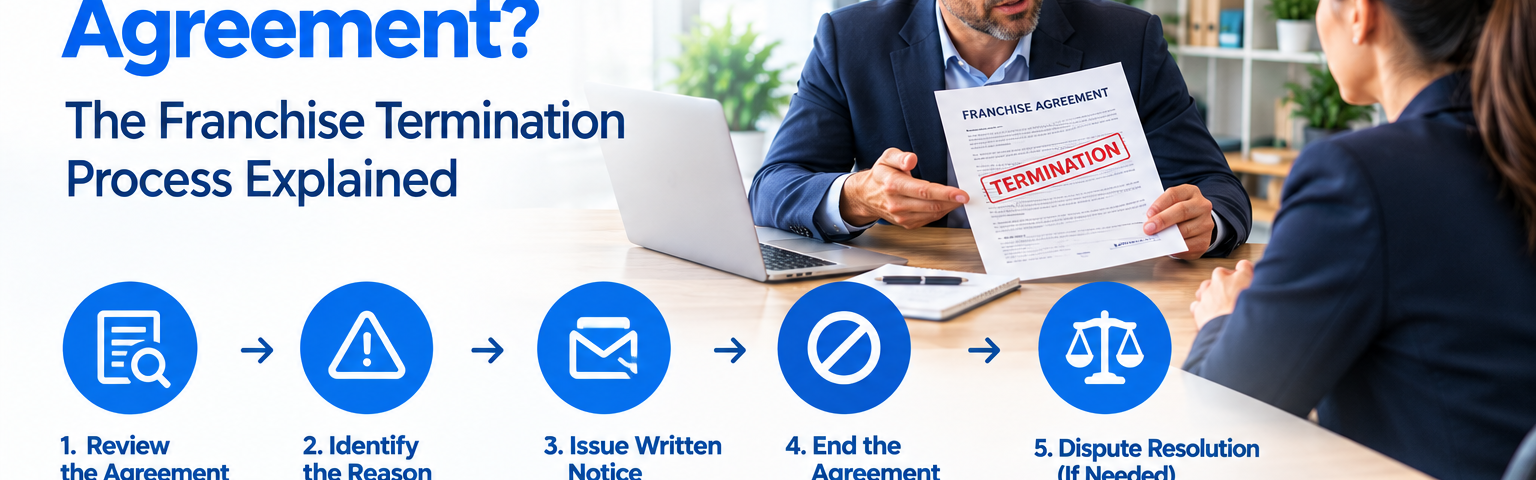
The franchise termination process usually begins when the franchisor identifies a potential breach or another contractual reason for ending the relationship. The franchisor should review the relevant agreement to establish whether termination is permitted and what procedure applies.
Where required, the franchisor issues a written notice explaining the alleged breach and the action needed to resolve it. Some agreements provide a cure period, giving the franchisee a specified amount of time to correct the problem. If the breach remains unresolved after that period, the franchisor may be entitled to issue a termination notice.
For serious breaches, the agreement or applicable law may permit immediate termination, although this should not be assumed without reviewing the relevant provisions.
Once termination takes effect, the franchisee may need to stop using the brand’s trademarks, remove signage, return confidential materials, settle outstanding payments, and comply with any post-termination obligations. The agreement may also contain provisions covering equipment, inventory, customer records, and restrictions on competing activities.
Can a Franchisee Challenge a Termination?
A franchisee may be able to challenge a termination if the franchisor has failed to follow the contract, relied on grounds that do not justify termination, or breached applicable legal requirements.
Depending on the circumstances, the parties may attempt to resolve the dispute through negotiation, mediation, or another dispute resolution procedure specified in the agreement. Court proceedings or arbitration may be necessary if the dispute cannot be resolved.
Franchisees should retain relevant correspondence, payment records, notices, and other evidence. Obtaining legal advice promptly is important, particularly when a termination notice includes a deadline or when the business faces an immediate risk of closure.
Conclusion
A franchisor can terminate a franchise agreement when the contract and applicable law permit it, but the process is governed by specific rights, obligations, and procedural requirements. Common reasons include contractual breaches, unpaid royalties, misuse of intellectual property, and serious operational failures.
Understanding the termination provisions before signing a franchise agreement can help both parties manage risks and avoid costly disputes. If termination becomes a possibility, reviewing the contract, following the required procedures, and obtaining appropriate legal advice can help protect the interests of everyone involved.